

Following pandemic-driven office downsizing and reorientation toward communal space—more “we,” less “me”—employees want their desks back.
Demand for quiet space and an opportunity to keep personal items at work emerged as key themes in Gensler’s 2025 Global Workforce Survey. According to the design firm’s latest research, people who describe their office as a “high-performing workplace” are more than three times more likely to say they have access to spaces for focused concentration than are people who work in a low-performing workplace.
“If you don’t plan for a dedicated workstation for an employee, you shouldn’t plan on them coming back,” says Brian Woolsey, cofounder and principal of Monarch Commercial Real Estate in Minneapolis.
But that’s tough to pull off when businesses have reduced their office space since the start of the pandemic—by 22% per person, on average, according to brokerage firm CBRE. Only 14% of organizations still allocate a desk for every employee, according to its 2024–25 Global Workplace & Occupancy Insights report. But 2024 marked the first year since 2020 that the ratio of desks to employees grew by 10 percentage points.
Jim Montez, a vice president with Transwestern Real Estate in Minneapolis, is watching the trend play out nationally: “Google and Facebook have been reintroducing individual desks and work pods to provide more privacy and flexibility. Law firms and financial institutions, such as McKinsey, are creating private, soundproof spaces alongside open areas. Companies like Microsoft are investing in private work pods to give employees a sense of ownership over their space.”
Locally, at SPS Tower in downtown Minneapolis, longtime tenant Accenture just completed a major remodel that included adding more individual spaces and small enclosed rooms for groups of two or three. The consulting firm practiced “hoteling” before it became a commonplace. “As a professional services firm, we don’t want our people in the office that much—they should be out billing,” says Scott Cummings, Accenture’s Minneapolis market lead. But consultants are traveling less as video conferencing has become normalized. “Because we’re doing more virtual work, we’re on calls more often, and it’s louder. People want privacy.”
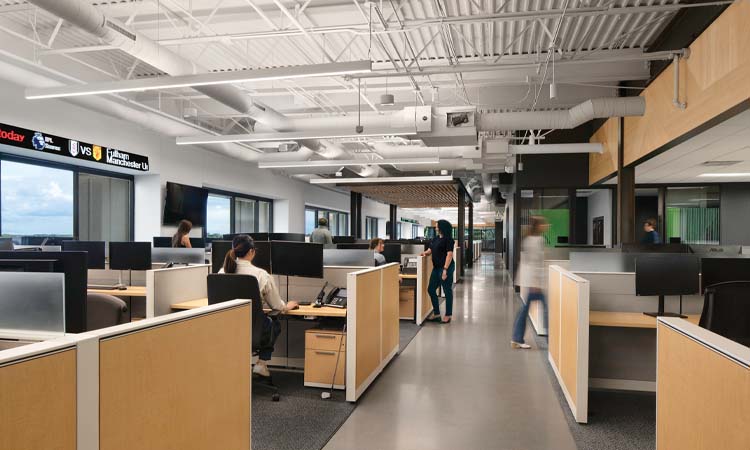
Smaller workstations are one way companies are making room for more individual desks, Woolsey says. Companies are also investing in better acoustics—redoing mechanical systems, adding extra insulation, installing soundproof glass walls to create privacy without erecting old cubicle walls, says Betsy Vohs, founder and CEO of Minneapolis architecture and design firm Studio BV. “The feedback CEOs are getting from employees is ‘I can’t do my calls here.’”
But those same employees who crave quiet and dedicated space want the modern office perks, too. In-person team meetings, working side by side and socializing with colleagues are among the top reasons white-collar workers go into the office, according to the Gensler survey.
“Amenities are not optional—they’re key to attraction, retention, and overall employee well-being,” says Deanne Erpelding, managing director of Gensler’s Minneapolis office. She advises business clients to think about spaces that will bring people together in less formal ways than a boardroom does.
Traditional conference rooms with a table and chairs are no longer the go-to choice for in-office interactions. Rooms or areas with moveable soft seating for a variety of interactions—group discussions, impromptu conversations, creative brainstorming—are a top preference for in-person teamwork, Gensler’s survey finds.
Erpelding says two of the most important office features today are a “hospitality-forward” lounge environment and a café or food hall setting.
Creating spaces that encourage spontaneous interactions becomes a key office function when most employees are hybrid. “A big café helps to get away from a microculture—it’s an important way to meet people on other teams, connect across divisions,” Studio BV’s Vohs says.
“They’re signing 10-year leases [but] work is changing every 18 months.”
—Betsy Vohs, CEO, Studio BV
But the Ping-Pong table and indoor putting green? You might be able to clear the games out of the office, Vohs says, as those sorts of attractions have become the catnip Class A buildings are using to attract tenants. SPS Tower, for example, features a gaming lounge, podcast studio, and Frgmnt coffee bar for all tenants.
The Colonnade in Golden Valley—home to Pentair, Inspire Medical Systems, and Bell Bank—recently completed its first renovation since the building’s opening in 1988, and it was all about perks. There’s a private tenant lounge with a golf simulator, bar, and fireplace, plus a patio that tenants can rent, and a lobby café.
Read more from this issue

Off-loading those features to the building allows companies to dedicate more space to focused workspaces, says Vohs, who believes this is the prudent move with office usage picking up. But as clients invest in glass dividers and phone booths, they look to Vohs to assure them these are good long-term investments. And that, she says, is tricky.
“They’re signing 10-year leases [but] work is changing every 18 months,” Vohs says. “They’re trying to predict the future at a time when it’s tough to see what next year will bring.”
link